

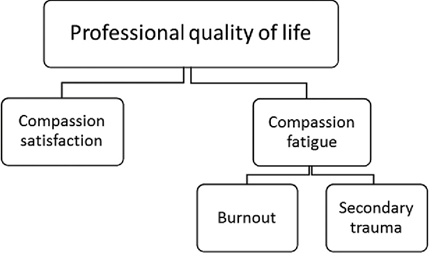
A nurse’s professional quality of life is dictated the person’s level of compassion satisfaction and compassion fatigue (Stamm, 2010). Left untreated, compassion fatigue leads to burnout and secondary trauma in nurses. This results in nurses providing poor quality patient care due to the symptoms of compassion fatigue and burnout, which can include difficulty concentrating, overwhelming grief, and anxiety. Consider today’s environment, where nurses are being exposed to an exceptionally high number of critically ill and dying patients due to the COVID-19 pandemic. This scenario is playing out all over the world: China, Italy, and the United States. What is going to happen to all of those nurses when the pandemic stops because a vaccine is discovered? What is going to happen to all of that secondary trauma related to caring for so many dying people without the resources nurses need to keep themselves safe? To gain a better understanding of a provider’s perspective who is in the midst of this international emergency, read this article and this article.
If they are able, nurses may leave their jobs for an “easier position” elsewhere, only to find that their unresolved compassion fatigue and trauma follows them. Ultimately, nurses may leave the profession entirely because they are unable to cope with their secondary trauma any other way.
Healthcare systems should have a vested interest in reducing the incidence of compassion fatigue and burnout in their nurses. In reducing compassion fatigue, healthcare systems will increase nursing retention. Consider this: the cost to train a new nurse to an inpatient unit can be as high as $88,000 (Jones, 2008; Lewin Group, Inc., 2009). For every nurse that a hospital loses to another facility, that organization needs to pay another $88,000 to train someone as a replacement. Also consider the fact that a nurse’s value increases over time. As that nurse gains more experience, that nurse will develop a better skill set to care for higher acuity patients and improve patient outcomes.
Now consider the fact that health insurance costs employers an average of $6,896 for single coverage in 2018 (The Kaiser Family Foundation, 2018). Even if employers splurge on high quality, broad coverage mental health benefits, they will still be spending significantly less in proactively treating and preventing compassion fatigue compared to the cost of training a replacement nurse. Creating a healthy work environment that encourages self-care, the appropriate use of mental health benefits, and teamwork will foster a culture that accepts and treats compassion fatigue as a normal part of the nurse’s professional life. This will improve the professional quality of life for nurses. By reducing compassion fatigue, employers will increase their nursing retention rates, therefore keeping experienced nurses and improving patient outcomes. The next time a pandemic comes around, it will be vitally important that highly trained nurses are available to care for patients in order to save lives.
References
Jones, C. (2008). Revisiting nurse turnover costs: Adjusting for inflation. Journal of Nursing Administration, 38(1), 11-18. Retrieved from https://www.ncbi.nlm.nih.gov/pubmed/18157000
Lewin Group, Inc. (2009). Evaluation of the Robert Wood Johnson wisdom at work: Retaining experienced nurses research initiative. Retrieved from http://www.issuelab.org/resource/evaluation_of_the_robert_wood_johnson_wisdom_at_work_retaining_experienced_nurses_research_ initiative
Stamm, B. H. (2010). The concise ProQOL manual. Retrieved from https://proqol.org/uploads/ProQOLManual.pdf
The Kaiser Family Foundation. (2018). Employee health benefits: 2018 summary of findings. Retrieved from http://files.kff.org/attachment/Summary-of-Findings-Employer-Health-Benefits-2018
 Nurses and Compassion Fatigue
Thank you for your thoughtful post. I am currently working on the COVID unit at my hospital, and like many of us, I know the truth of your words: we will never be the same.
You make a good point that the cost of replacing a nurse has a high dollar value, and therefore deserves the attention of nursing management. I can honestly say that my compassion fatigue is being managed, and it’s coming from an unexpected source. I am remaining hopeful because our management team is present on the floors, analyzing our resources, and making proactive changes based on our input. For example, we now have a turn team to help prone ventilated patients safely. We still have issues with insufficient personal protective equipment, but our leaders’ continued presence tells me they are with us. Their presence reminds me of Paul Farmer’s recommendation to healthcare providers to remove the hierarchy and walk alongside their patients so we can better help them (2013). And management are showing their support with human touches like decorating the walls with children’s drawings and messages that we are loved, the doctors provide lunch, and we get daily Facebook messages from management. So while offering mental health services is nice, offering working solutions is a greater relief. With their help, I know I can sustain my efforts.
Reference
Farmer, P. (2013). Reimagining accompaniment: A doctor’s tribute to Father Gustavo Gutiérrez. Retrieved from Partners in Health: https://www.pih.org/article/in-the-company-of-the-poor
LikeLike
I understand that the experience of healthcare providers in New York is something they never expected. I think for the rest of the country it is something we will never face on that scale. A majority of the country is not set up like New York and will not be hit hard by this pandemic. I think hospitals need to focus on how hard healthcare providers work all the time not just when faced with a crisis. Employees need to be appreciated and made feel supported all year long. It is amazing the kindness being shown to hospitals, treating us like we are heroes when this is what we do every day, even without a pandemic.
My point is that we need to move past what is happening now and focus on appreciating healthcare workers for all they do every day to make patients’ lives better. I think appreciation and support from healthcare systems will help with the retention of highly skilled nurses to staying with a company long term and providing great patient outcomes.
There are many factors that can help with employee support and retention. It is not all about financial support. Poor management, lack of teamwork lack of support from supervisors, professional development, opportunities for promotion, and poor work conditions all contribute to employee satisfaction. Mental health benefits should be part of the picture especially for healthcare providers facing a major crisis, but also for those who face the tragedy families deal with all year long not related to the pandemic.
Afolabi, A., Fernando, S., & Bottiglieri, T. (2018). The effect of organizational factors in motivating healthcare employees: a systematic review. British Journal of Healthcare Management, 24(12), 603-610.
LikeLike
As you know working in healthcare takes its toll on you then you add the aspects of pandemic things are in constant change and change is hard. We all have a routine and flow that comes with our day to day work as nurses, now that whole flow has changed due to new policies and procedures due to the pandemic, not to mention the stress of not having the proper equipment, the patients can not have visitors so you feel it is your responsibility to be their family/visitor spend extra time with them so they know that they are not alone. The secondary trauma and burnout from being on the edge trying to maintain safety and the care of patients is a heavyweight to carry. Self- care is very important in our roles and unfortunately we all are not good at taking care of ourselves. Then you get home and have nothing left to give your real family. Now with the pandemic, we are seeing our own fall ill to this disease and watching more people take their last breaths alone without family only to call the family to tell them they are gone. Your blog and the awareness surrounding protecting yourself with self-care and awareness of compassion fatigue is essential right now.
LikeLike